


Makaylah Rogers – a long time resident of Canmore – felt and saw a strong need for more mental health support and community building for other residents of the Bow Valley. To address this gap, they started a company with their wife, but the nature of their solution might surprise some. They created Frankie D’s Donuts.
By Kayla MacIntosh, 2025
The Bow Valley boasts some of the most beautiful places in Alberta – Banff, Canmore, Lake Louise, and Kananaskis to name just a few. As such, it has become one of Canada’s most popular tourist destinations. While living in such a stunning place comes with some obvious benefits, it also poses challenges to many residents.
Makaylah Rogers, a long time Canmore resident explains, “[as residents], we’re very lucky and blessed to live here in the mountains, where people …travel thousands of kilometers to come and visit, and we get to walk out our door and be here every day. I think the paradox side of it is that it’s incredibly isolating for residents, and we have a lot of mental health struggles.”
While 18% of Canadians are experiencing mental illness or substance use disorder, that number jumps to 27% in the Bow Valley (Statistics Canada, 2022; Banff Canmore Foundation, 2025). Makaylah points out that many of the residents are newcomers to Canada, and therefore might experience increased rates of isolation.
“They leave home or family to travel here and to work here and to service the tourism industry. And in my own personal experience, because the mountains are so beautiful and you [feel] so lucky to live here, depression can seep in with isolation and [you] can feel like ‘I should be more happy, I should be more grateful, I shouldn’t complain’,” says Makaylah.
Furthermore, 2SLGBTQIA+ people experience far higher rates of mental health difficulties. (Kingsbury and Findlay, 2024). Makaylah is non-binary, and having struggled with their own mental health, it was important to them to find ways to support other members of the 2SLGBTQIA+ community.
With so many residents experiencing mental health struggles, feelings of isolation and a lack of community, Makaylah knew they had to do something about it.
Makaylah decided they wanted to create an organization where Bow Valley community members could come together to have conversations about mental health and support each other, but they didn’t know exactly what form that organization would take. At the same time, Makaylah’s wife, Fia-Lynn, began a new hobby of baking.
“The first thing she made was donuts, which I thought was very random, because I feel like if you’re going to start baking as a hobby, you start with brownies or cupcakes – not a complicated thing, like donuts, but that’s her.”
While brainstorming what sort of product or brand this organization was going to have, Makaylah took a fateful call with a friend who shared about her own business, saying she ‘accidentally started a donut business’.
Makaylah recounts the conversation, “Wow, that’s the best sentence I’ve ever heard! How do you accidentally start a donut business? I ran out to my wife and was like, ‘we should deliberately start a donut business,’ to which she was like, ‘we don’t know how to make donuts, and we’re not bakers, and we’re not trained.’ And just saying that, one thing led to the other, and it became the perfect product.”
Thus Frankie D’s Donuts was born.
Who’s Frankie you may ask?
A friendly, goofy, labradoodle. Makaylah and Fia-Lynn decided to name the organization after their loving companion who Makaylah cites as a major contributor to the recovery from their own mental health struggles.

While the donuts were delicious and growing in popularity, the mental health focus remained at the core of the business.
In May of 2024, Frankie D’s hosted an event called Ending Stigma, One Donut at a Time: Diverse Perspectives on Mental Health in partnership with Banff Mental Health & Addictions Week and Kristy Wolfe Stories. The event saw 60 residents come together to hear a diverse panel share personal stories on complex mental health topics. The panel included Indigenous Peoples, newcomers, 2SLGBTQIA+ folks, and people who have experienced poverty and/or childhood trauma. Each shared on mental health from their unique perspectives.

One participant said, “I felt more a part of the community by being at this event,” while another noted, “I was impacted hearing the stories of others, especially from Indigenous community members.”
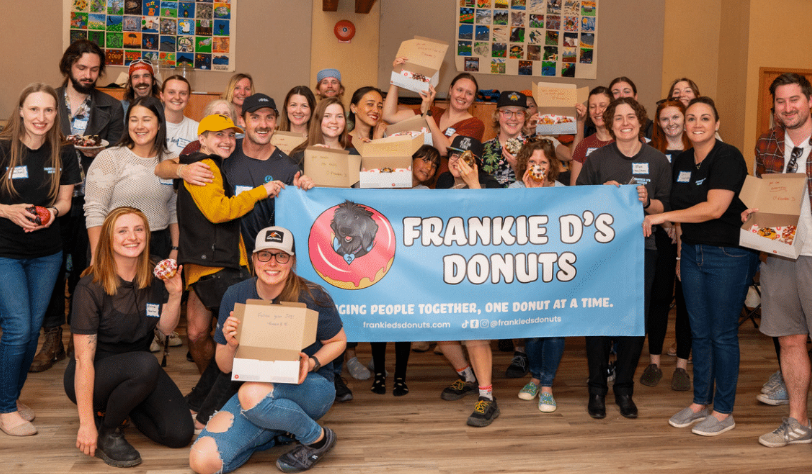
But the outreach didn’t stop there. Later that week, they hosted a workshop: Donut Decorating & Making New Friends. This event was created to specifically address how hard it can be to make new friends as an adult.
“We wanted to create a less intimidating way to start some of these conversations, by distracting people by doing something with their hands. So we created donut decorating, where people come together, [and should they choose], they sit at tables with people that they don’t know…to make new friends,” explains Makaylah.
The workshop was a great success. One participant, Ariole, noted, “This was absolutely fantastic! Connecting with new people in a fun, playful, safe, and respectful space.” Another attendee, Milly, said, “This was a beautiful way to spend an evening, with donuts and strangers being so open and vulnerable.”
The Donut Decorating workshop also had a 2025 iteration. It should come as no surprise that the event was once again, a stellar success. Participants passionately applauded the event. One attendee raved, “I didn’t realize that there is a lot of opportunity to meet new people and potential friends in my six years of living in Banff. I am so glad to have met my table-mates! The best part is that some of us really connected with each other.”

Held in May 2025, Donuts & Conversation: Tote Bags for Hard Times once again gathered residents to facilitate open and supportive conversations about mental health. But this year, conversation focused on plainly talking about suicide, suicidal ideation, and how to find comfort in hard times. Attendees were given tote bags and encouraged to fill it with a variety of items – most donated by local organizations and community members.
However, these were not mere gift bags. Makaylah explains, “It was a tote bag that we had designed, and they put stuff into it to take home – and they left with hundreds of dollars worth of items in every bag, so that when they then hit loneliness, hit isolation, have that struggle, those hard thoughts, they’ve preventatively got something to reach for that they had already prepared in advance… What we’re trying to do is kind of raise awareness that we need more preventative approaches.”
One participant sums it up, “I was touched by strangers opening up to share. It’s a beautiful experience and a reminder that you aren’t alone. I felt heard. And it felt ok to be me during the event. I feel lucky to be a part of this community.”
While some might not consider donuts when they think of healthy eating, Makaylah asserts that every food has its place. Healthy eating is all about balance, and it looks different for every person. There is no such thing as ‘good food’ and ‘bad food’. Makaylah explains, “we’re really about balance and [food] neutrality and believing that we deserve sweet things in life, and that can come from food, but it can also come from experiences.”
Who would have thought that donuts could bring so many people together to connect, to talk about mental health and to reduce stigma? But Frankie D’s did just that, and many residents of the Bow Valley will be thrilled to learn that this is just the beginning for the organization.
References:
“Mental disorders in Canada,” Statistics Canada. (September, 2022). https://www150.statcan.gc.ca/n1/pub/11-627-m/11-627-m2023053-eng.htm
“Metal Health & Wellbeing Vital Signs Report,” Banff Canmore Foundation. (Feb 12, 2025). https://banffcanmorefoundation.org/wp-content/uploads/BVVS-MentalHealth-BCF.pdf
Kingsbury, Mila and Findlay, Leanne. “Mental health and access to support among 2SLGBTQ+ youth,” Statistics Canada. (November 20, 2024). DOI: https://www.doi.org/10.25318/82-003-x202401100002-eng