


Looking to expand your knowledge of Equity, Diversity and Inclusion (EDI) in recreation settings?
Incorporating strategies that enhance and respect the equity, diversity and inclusion of all individuals is vital to reducing health inequalities and ensuring the benefits of recreation are universal. Our FREE online eCourse aims to teach actionable skills around improving equity, diversity, and inclusion (EDI) in recreation settings.

EDI Definitions
Below are some standard terms and language used when discussing the topics of Equity, Diversity and Inclusion. Definitions come from several leading resources, universities and leaders in EDI work.
Allyship
The word ally is a verb, not a noun, meaning it’s a continuous action and an ongoing commitment to standing for and with vulnerable individuals and communities.
Bias
“The conscious (explicit) or unconscious (implicit) opinion, preference, prejudice, or inclination formed without reasonable justification that prevents a balanced or even-handed judgement”(1).
Diverse & Equity Deserving Groups
“Communities that identify barriers to equal access, opportunities, and resources due to disadvantage and discrimination, and actively seek social justice and reparation”(2) . Diverse & Equity Deserving Groups include but are not limited to Indigenous People, People who are racialized, Women, 2SLGBTQIA+, People living with disabilities/ mobility needs, People experiencing poverty or low income, People experiencing homelessness or precarious housing, People experiencing mental illness, and People experiencing addictions.
EDI Lens
An EDI Lens is a systematic tool that enables the intentional incorporation of EDI principles into daily practice. This can include thinking about work practices or the experience of a marginalized group differently, identifying unconscious biases, and helping ensure that everyone is treated with respect and dignity.
Equity
Equity is where everyone is treated according to their diverse needs in a way that enables all people to participate, perform and engage to the same extent(1).
Diversity
Diversity is about the individual. It is about the variety of unique dimensions, qualities, and characteristics we all possess, and the mix that occurs in any group of people. Race, ethnicity, age, gender, sexual orientation, religious beliefs, economic status, physical abilities, life experiences, and other perspectives can make up individual diversity. Diversity is a fact, and inclusion is a choice(1).
Health Inequity
Health inequity refers to health inequalities that are unfair or unjust and modifiable. For example, Canadians who live in remote or northern regions do not have the same access to nutritious foods such as fruits and vegetables as other Canadians(3).
Inclusion
Inclusion is creating a culture that embraces, respects, accepts and values diversity. It is a mindful and equitable effort to meet individual needs so that everyone feels respected, valued, and able to contribute to their fullest potential. Where diversity occurs naturally, creating the mix in the organization, inclusion is the choice that helps the mix work together(1).
Intersectionality
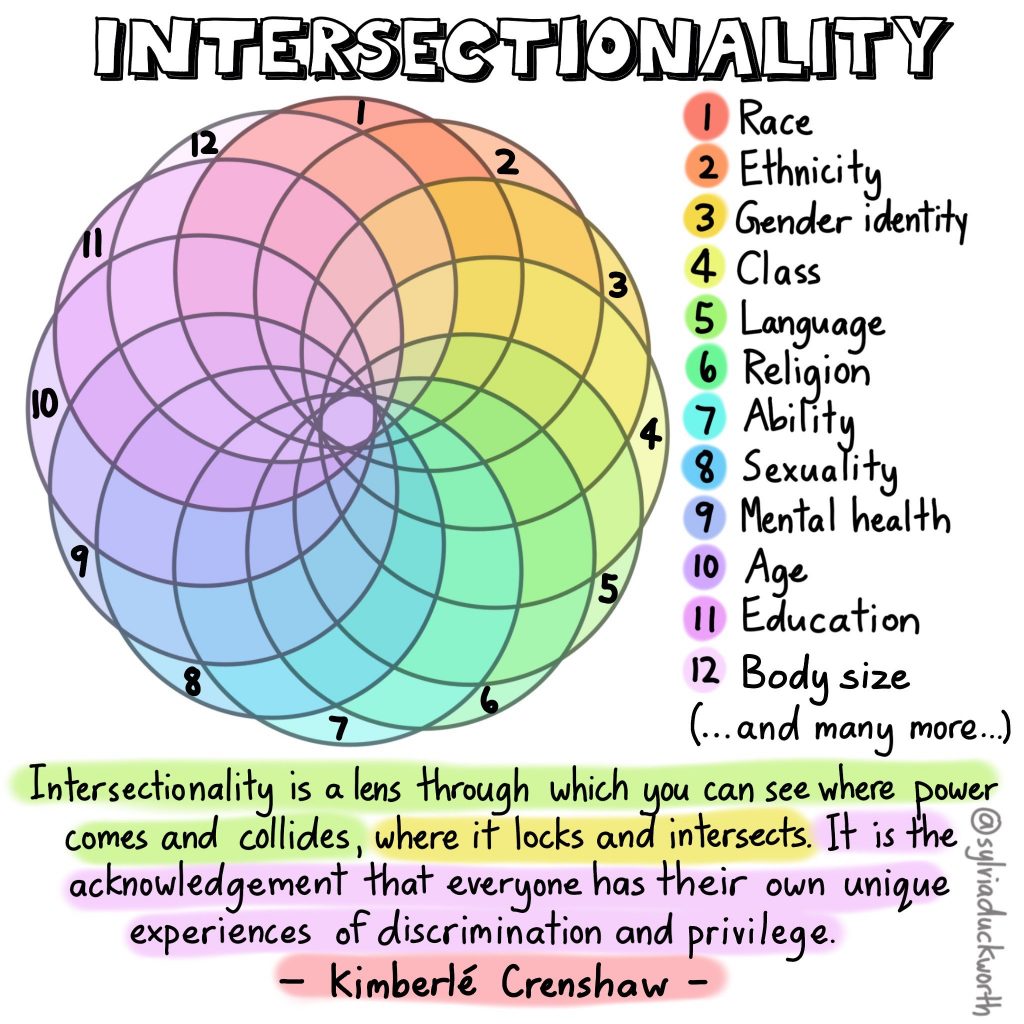
Intersectionality, developed by Kimberlé Williams Crenshaw in 1989, considers how social diversity such as race, class and gender, sexuality, and disability do not exist separately or in isolation from each other. Instead, it assesses how diversities affect one another and can create different modes of oppression.
Marginalized
“A social process by which individuals or groups are (intentionally or unintentionally) distanced from access to power and resources and constructed as insignificant, peripheral, or less valuable/privileged to a community or “mainstream” society”(4).
Performative Allyship
Performative Allyship is surface-level action done with the intention of it benefiting the person doing it, rather than the vulnerable individuals and communities it was done for. It can also be described as “talking the talk, but not walking the walk”.
Power
“The ability to exercise one’s will over others. Power occurs when some individuals or groups wield a greater advantage over others, thereby allowing them greater access to and control over resources. Wealth, whiteness, citizenship, patriarchy, heterosexism, and education are a few key social mechanisms through which power operates”(5).
Privilege
Privilege is “the experience of freedoms, rights, benefits, advantages, access and/or opportunities afforded to members of a dominant group in a society or in a given context”(6).
Reconciliation
Reconciliation can mean and look different to everyone. At its core, the Truth and Reconciliation Commission of Canada recognizes it as “establishing and maintaining a mutually respectful relationship between Aboriginal and non-Aboriginal peoples in this country. In order for that to happen, there has to be awareness of the past, an acknowledgement of the harm that has been inflicted, atonement for the causes, and action to change behaviour”(7).
Reconciliation really begins with an internal process of education and awareness, from there it’s about authentic relationship building on the foundations of mutual respect and traditional knowledge.
System(s)
“A system is a way of working, organizing, or doing something which follows a fixed plan or set of rules”(8). Systems are foundational to how we interact with, move through and live in the world.
Systemic Barriers
Systemic Barriers are deeply ingrained barriers that have been built into the way a society functions and exclude groups of people from participation and benefits of social and economic life. Our assumptions and biases along with policies, places, partnerships, programs, promotion, participation (7 Pillars) and our overall practices reinforce them.
Tokenism
Tokenism can be defined as “the practice of doing something (such as hiring a person who belongs to a minority group) only to prevent criticism and give the appearance people are being treated fairly”(9).
Unconscious Bias
Unconscious biases are strong social stereotypes about certain groups of people that form outside of your own conscious awareness.
Equity, Diversity and Inclusion in Recreation Settings eCourse
Looking to expand your knowledge of Equity, Diversity and Inclusion (EDI) in recreation settings?
Incorporating strategies that enhance and respect the equity, diversity and inclusion of all individuals is vital to reducing health inequalities and ensuring the benefits of recreation are universal. Our FREE online eCourse aims to teach actionable skills around improving equity, diversity, and inclusion (EDI) in recreation settings.
Further Your Understanding
Check out these websites for more definitions and key terms when discussing Equity, Diversity and Inclusion:
- Canadian Centre for Diversity and Inclusion Glossary of Terms
- National Association of Counties: Diversity, Equity and Inclusion Key Terms and Definitions.
- University of British Columbia: Equity & Inclusion Glossary of Terms
Continue Exploring People

People – Home
People
People
People – Home
An EDI Lens is a systematic tool that enables the intentional incorporation of EDI principles into daily practice.
Getting Started with an EDI Lens
Getting Started with an EDI Lens
An EDI Lens is a systematic tool that enables the intentional incorporation of EDI principles into daily practice.
Explore the different opportunities and strategies to apply an EDI Lens to HEAL initiatives within the context of the Healthy Communities Framework.
Supporting EDI In Your Community
Supporting EDI In Your Community
Explore the different opportunities and strategies to apply an EDI Lens to HEAL initiatives within the context of the Healthy Communities Framework.

Intentional consideration is required to ensure that Indigenous People experience both equity and inclusion within the community.
EDI – An Indigenous Context
EDI – An Indigenous Context
Intentional consideration is required to ensure that Indigenous People experience both equity and inclusion within the community.
- Canadian Centre for Diversity and Inclusion. Glossary of Terms: A reference tool. [report on internet]. The organization; 2022 [cited 2022 July 8]. Available from: https://ccdi.ca/media/3150/ccdi-glossary-of-terms-eng.pdf
- Canadian Kinesiology Alliance. [Internet]. Inclusion Statement; n.d. [cited 2022 July 8]. Available from: https://www.cka.ca/en/cka-inclusion#:~:text=Equity%2Ddeserving%20groups%3A%20Communities%20that,seek%20social%20justice%20and%20reparation.
- Government of Canada. [Internet]. Social determinants of health and health inequalities; June 2022 [cited 2022 July 8]. Available from: https://www.canada.ca/en/public-health/services/health-promotion/population-health/what-determines-health.html
- The University of British Columbia. [Internet]. Equity & Inclusion Glossary of Terms; n.d. [cited 2022 July 8]. Available from: https://equity.ubc.ca/resources/equity-inclusion-glossary-of-terms/#
- National Association of Counties. [Internet]. Diversity, Equity and Inclusion; Key Terms and Definitions; n.d. [cited 2022 July 8]. Available from: https://www.naco.org/resources/featured/key-terms-definitions-diversity-equity-inclusion
- City of Ottawa & City for All Women Initiative. Equity & Inclusion Lens Handbook. [report on internet]. Ottawa; The City & Initiative; 2018 [cited 2022 July 8]. Available from: https://www.cawi-ivtf.org/sites/default/files/publications/ei-lens-handbook-en-web-2018.pdf
- Truth and Reconciliation Commision of Canada. Honouring the Truth, Reconciling for the Future Summary of the Final Report of the Truth and Reconciliation Commission of Canada. [report on internet]. The Commision; 2015 [cited 2022 July 8]. Available from: https://ehprnh2mwo3.exactdn.com/wp-content/uploads/2021/01/Executive_Summary_English_Web.pdf
- Collins Dictionary. [Internet].System; n.d.[cited 2022 July 19]. Available from: https://www.collinsdictionary.com/us/dictionary/english/system
- Government of Canada. [Internet]. Best Practices in Equity, Diversity and Inclusion in Research; June 2021 [cited 2022 July 8]. Available from: https://www.sshrc-crsh.gc.ca/funding-financement/nfrf-fnfr/edi-eng.aspx?wbdisable=true#:~:text=Tokenism%20can%20be%20defined%20as,meaningful%20actions%20toward%20EDI%20in