


Welcome to the Promotions Pillar! We’ve enhanced the user experience by providing an interactive video and workbook that takes you through this pillar so that you can feel equipped and confident to take action in building healthy places in your community. Remember – This is a ‘choose your own’ adventure so you can choose which tools to use in this journey.
Within the context of Healthy Eating and Active Living (HEAL) initiatives, developing a Promotional Plan is a key tool to ensuring you can communicate and connect well with the community. Developing a Promotional Plan helps your community HEAL initiative to be successful by(1):
- Providing a framework for identifying who you need to reach and how
- Honing and targeting your messaging, making it effective, efficient, and long-lasting
- Making the community aware of your organization’s services and successes
- Finding and securing funding sources
- Interactive Video
- PDF Workbook
- Read on the Web
Why Promote?
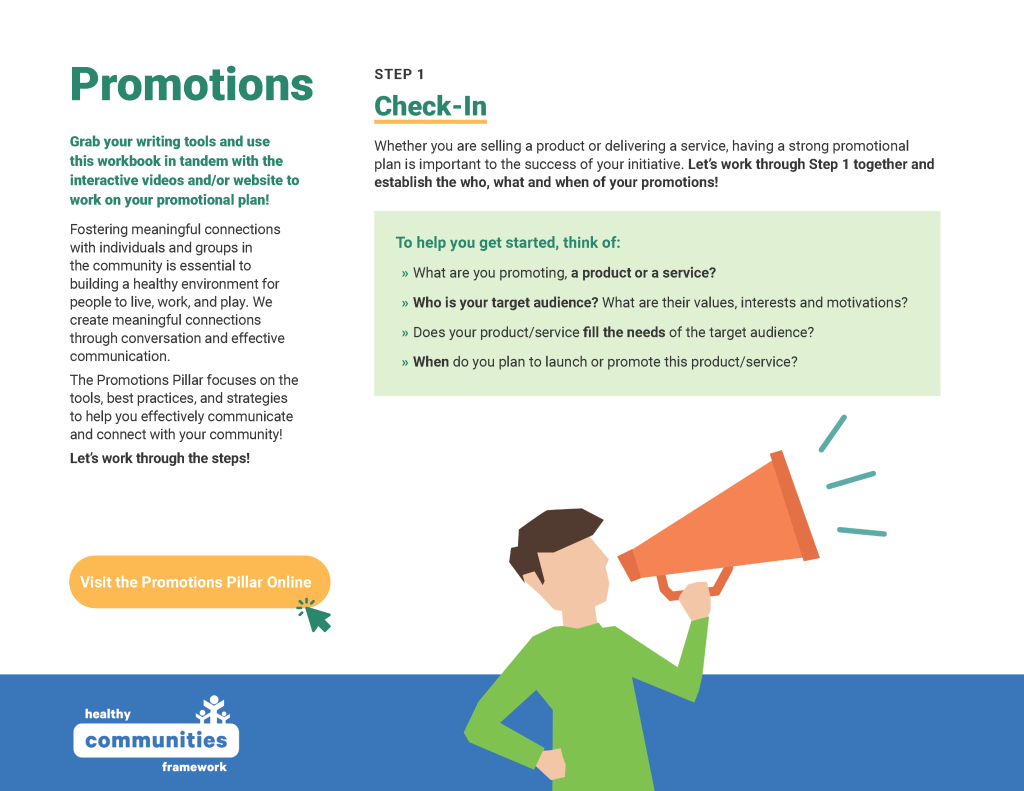
Fostering meaningful connections with children, youth, families, and individuals in the community are essential to building a healthy environment for people to live, work, and play. We create meaningful connections through conversation and effective communication.
Within the context of Healthy Eating and Active Living (HEAL) initiatives, developing a Promotional Plan is a key tool to ensuring you can communicate and connect well with the community. Developing a Promotional Plan helps your community HEAL initiative to be successful by(1):
- Providing a framework for identifying who you need to reach and how
- Honing and targeting your messaging, making it effective, efficient, and long-lasting
- Making the community aware of your organization’s services and successes
- Finding and securing funding sources
The Promotions Pillar focuses on the tools, best practices, and strategies to help you effectively communicate and connect with your community. Let’s get started by first reading through some definitions before learning how to develop a promotional plan!
Definitions
Read below for common terms, language, and context for discussing promotions, marketing, and communications.
A communications strategy focuses on writing a compelling story or message to engage and retain the target audience using their attitudes, values, and drivers to resonate with them. Compared to the marketing strategy, which covers distributions, the communications strategy is the development of the messaging or language to inform the target audience(2).
A marketing strategy uses trends and behaviours to inform how to best target, advertise, or promote to the target audience. Marketing strategies outline the tactics for how the message will be distributed and consists of four main activities: product, price, place, and promotions(3).
Product(4):
Product is the item or service that an organization sells or provides. The product is what you make available to the customer or the target audience. Understanding the product informs the other Ps of marketing (where to place, how to price and promote).
Price(4):
The amount of money that you charge for the product or service. Price is informed by the product’s real and perceived value, which, when altered, influences people’s decision-making.
Place(ment)(4):
Place can refer to the physical location where you sell the product or service and the placement of the item within the selling location. It can also refer to where you advertise or promote your product (social media, webpage, etc.). The goal is to choose the best place to get your product or service in front of your target audience.
Promotion(4):
Promotion refers to the communication strategy: the messages or stories highlighting why the target audience needs the product or service, what problem you are solving and why they should participate in or pay for your product.
A SWOT analysis is a tool that compares strengths, weaknesses, opportunities and threats. Using a SWOT analysis helps the team to think about challenges and how to overcome them and helps determine which decisions may bring success(5).
Strengths:
Strengths are the internal factors that improve your position in the marketplace. Strengths include the various skills, capabilities, proficiencies, and benefits that competitors can’t easily copy.
Weaknesses:
Weaknesses are the internal gaps or limiting factors that reduce your ability to be competitive or achieve your goals or the goals of the product or service. Weaknesses include staff capacity, outdated tools or equipment, financial constraints, etc.
Opportunities:
Opportunities are the external environmental, societal, or political factors that offer new paths or options to grow and become more successful. Opportunities could include new municipal council members amenable to your organization’s goals, a new social media campaign bringing awareness to issues you can solve, etc.
Threats:
Threats are the external factors that negatively impact your ability to expand and grow. Threats include economic challenges, labour shortages, social norms, etc.
Community engagement is two-way communication with your target audience. It involves or facilitates the active participation of the target audience or community in the decision-making and planning process.
Community engagement strategies may incorporate promotional planning (marketing & communications) to reach potential participants and highlight the benefits of participation.
Promotional plans are one-way dialogue. It focuses on the marketing and communications strategies that create connections and conversations with the target audience.
Real value refers to the cost to produce or oversee the product or service, how useful it is to the user, and the value of the components.
Perceived value refers to how much the user feels the product or service is worth.
The goal should be to maximize perceived value while reducing the costs (aka the real value) of the product(6).
Overhead costs are any of the ongoing costs or fees needed to operate a business that are not related to the development of the product or service. Overhead costs can include: rent, utilities, insurance, legal fees, office supplies, employee payroll, administrative costs etc.
Developing a Promotional Plan
Use the Five Steps below to guide you through developing your own promotional plan!
Step 1: Identify Your Product
Step 2: Get to Know Your Community
Step 3: Set a Price
Step 4: Develop Your Message
Step 5: Review & Adapt
Continue Exploring Promotions

Tips & Tricks
Tips & Tricks
Tips & Tricks
Tips & Tricks
Promoting Healthy Eating
Promoting Healthy Eating
Promoting Healthy Eating
Promoting Healthy Eating
Promoting Active Living
Promoting Active Living
Promoting Active Living
Promoting Active Living

Uplifting Indigenous Voices through Storytelling
Uplifting Indigenous Voices through Storytelling
Uplifting Indigenous Voices through Storytelling
Uplifting Indigenous Voices through Storytelling
- Community Tool Box [Internet]. Section 1. Developing a Plan for Communication; 2022c [cited 2023 January 14]. Available from: https://ctb.ku.edu/en/table-of-contents/participation/promoting-interest/communication-plan/main
- Champlain College Online [Internet]. Marketing vs. Communications: A Comparison of Careers and Degrees; 2023c [cited 2023 January 14]. Available from: https://online.champlain.edu/blog/marketing-vs-communications-comparison-careers-and-degrees#:~:text=Marketing%20and%20communications%20share%20tools,bringing%20awareness%20to%20a%20brand
- University of Florida [Internet]. Blogs: Strategic Plan, Marketing Plan, Communications Plan: What’s the difference?; 2023c [cited 2023 January 14]. Available from: https://blogs.ifas.ufl.edu/fredept/2017/10/13/strategic-marketing-communications-plan-whats-the-difference/
- American Marketing Association [Internet]. The Four Ps of Marketing; July 2022 [cited 2023 January 14]. Available from: https://www.ama.org/marketing-news/the-four-ps-of-marketing/
- Business Development Bank of Canada [Internet]. How to write a marketing plan; n.d. [cited 2023 January 14]. Available from: https://www.bdc.ca/en/articles-tools/marketing-sales-export/marketing/5-no-nonsense-strategies-attract-customers
- Small Business CHRON [Internet]. Real Value vs. Perceived Value; 2023c [cited 2023 January 14]. Available from: https://smallbusiness.chron.com/real-value-vs-perceived-value-20857.html


